

A Strange Quantum Theorem Has Killed Einstein's Reality
Quantum mechanics describes particles with a wave function, or “quantum state,” that gives probabilities rather than definite facts. Charlie Wood tells the story of how physicists have argued over what that state means, as a series of three theorems. The first is the 1935 EPR argument. Einstein, Podolsky and Rosen used it to claim that the quantum state is an incomplete description of an underlying reality that is both objective and local. Bohr and the Copenhagen school answered by giving up the idea of an objective reality altogether.
The second is Bell’s theorem from 1964. John Bell showed that no theory that is both “real” and “local” can match every prediction of quantum mechanics. Experiments from the 1980s onward sided with quantum theory, so at least one of Einstein’s cherished assumptions has to go.
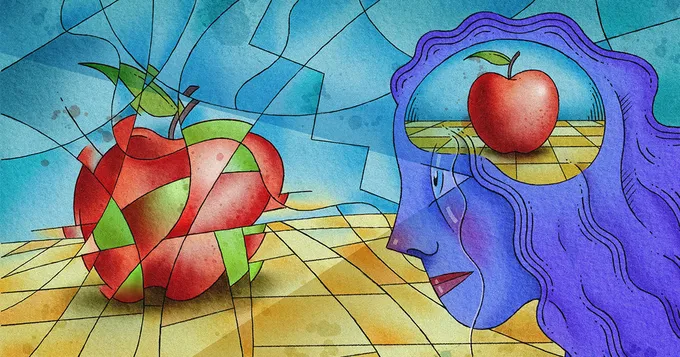
Many physicists hoped a middle path was still open: maybe the world is real, but the wave function only describes our knowledge of it, not the world itself. Robert Spekkens’s 2004 toy model made this “epistemic” view look promising. Then, in 2012, Matthew Pusey, Jonathan Barrett and Terry Rudolph published the PBR theorem. Pusey had tried to build such a knowledge-only theory and ended up proving that it can’t work. Wood explains the proof with a card-game analogy: if quantum states that “overlap” were just states of knowledge, certain outcomes would be possible, and quantum mechanics forbids them. Experiments, including a recent expanded version run on an IBM quantum computer, support the quantum predictions.
The article stresses that PBR doesn’t settle what reality is. It removes the comfortable middle option. Physicists are left with a starker choice: accept an objective reality in which the wave function is itself real and strange (the route Bohmian mechanics takes), or abandon objective reality, as Copenhagen-style views and QBism do. Wood ends with researchers such as Jacques Pienaar, David Schmid and Lucien Hardy, who are taking different routes out of the dilemma. Some are rethinking what “reality” could mean, for example by asking whether a state could be spread across time.