

Atom, Archetype, and the Invention of Synchronicity: How Carl Jung and Wolfgang Pauli Bridged Mind and Matter
The essay begins with Einstein’s remark that every true theorist is a kind of tamed metaphysicist. It then introduces Wolfgang Pauli (1900–1958), the Nobel-winning physicist behind the exclusion principle and the neutrino hypothesis. Pauli met the psychiatrist Carl Jung (1875–1961) some years after his Nobel Prize. Their friendship lasted about twenty-five years, until Pauli’s death, and it produced the concept of synchronicity. Popova locates their common ground in an analogy: the atom, with its nucleus and orbiting electrons, and the self, with its conscious ego and surrounding unconscious.
Much of the essay draws on their letters, collected in Atom and Archetype: The Pauli/Jung Letters, 1932–1958. Jung called the radioactive nucleus an apt symbol for the energy source of the collective unconscious. The exchange moved from analysing Pauli’s dreams to a broader parallel between matter and psyche. In 1937 Pauli criticised the narrow materialism of his own field and called for openness to other ways of knowing. He later wrote of a close fusion of psychology with the scientific experience of the material world. He also suggested that if quantum observations depend on the experimental setup, they might depend on the psyche of the observer too.
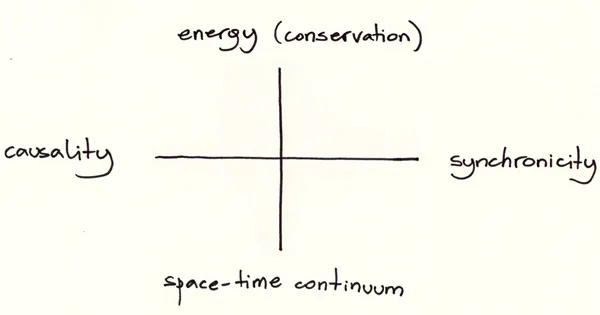
The term synchronicity took shape between 1948 and 1950. Pauli pointed Jung to Schopenhauer’s idea of meaningful coincidence. Jung described synchronicity as an ordering principle by which similar things coincide without any apparent cause. He proposed replacing strict causality with a “constant connection” through effect, and synchronicity with connection through contingency or meaning. Pauli pushed back. He preferred the term “meaning-correspondence” and doubted that microphysics has any use for the idea of meaning. He wanted synchronicity defined narrowly, as effects that show up in small numbers of cases and vanish in large ones. He also warned against using the concept of the archetype loosely in the acausal realm of microphysics.
The essay closes in the 1950s. Jung wrote of feeling isolated from his contemporaries and regarded as esoteric. Popova presents the correspondence as an open inquiry rather than a settled theory. Pauli himself called it a journey they were only just setting out on. She points readers to the full book for its many further parallels between psychology and physics.