

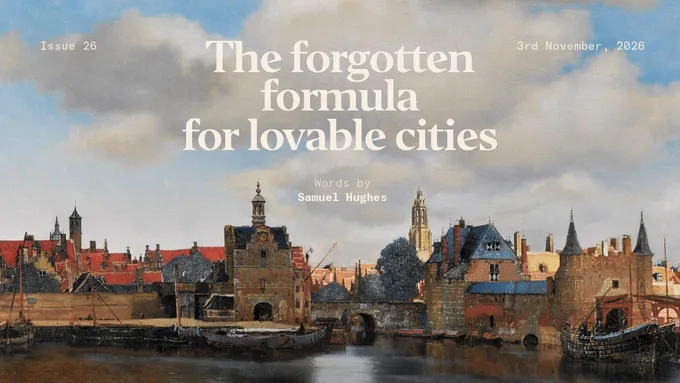
The forgotten formula for lovable cities
People love the old streets of Verona, Bruges and Prague. Many also love newer, plainer places like Osaka, Taipei and Hong Kong. The essay asks what makes a place lovable, and it finds an answer in Camillo Sitte, an Austrian architect. His 1889 book The Art of Building Cities was hugely influential in late nineteenth-century Europe. Modernism pushed it into obscurity in the twentieth century.
Two of Sitte’s principles concern enclosure and scale. A good square works like an outdoor room, with walls that streets don’t break up. He admired “turbine squares”, where streets enter at the corners in line with the building faces, and Barcelona’s Plaça Reial, whose entrances are mostly bridged over. He criticised open, weakly walled spaces such as Trafalgar Square and the Place de la Concorde. His rule of thumb was that a square should be no more than about twice the height of its main building. St Peter’s Square and Heroes’ Square in Budapest are examples of spaces too big for their buildings.
The next principles concern symmetry and the placement of monuments. Sitte thought rigidly symmetrical plans often look awkward from the ground, and that asymmetry isn’t disharmony. Statues belong along the edges of a square, not in its centre or on axis with a building. The Victoria Memorial in front of Buckingham Palace is a poor example. Major buildings should also be framed by ordinary ones. The essay cites the Parvis Notre-Dame, where clearing the surrounding streets left the cathedral looking smaller and lonelier. It also cites Vienna’s Votive Church, which Sitte wanted set within the ordinary urban fabric.
Sitte shaped planning in Munich, Berlin and Vienna, and early twentieth-century Helsinki neighbourhoods show his influence. Modernist planners preferred parallel blocks and open space, and dismissed him as a romantic. Sigfried Giedion called him “a kind of troubadour”. The essay argues that backlash against modernism has revived interest in him, citing New Urbanist towns and practices such as Ash Sakula. It closes by suggesting that his principles preserve a craft that was nearly lost, and that studying them helps today’s builders relearn it.